Global Warming as the Overarching Focus of Curriculum for Sustainability
Students Must Urgently Learn about
Climate Change and Renewable Energy Technologies and Possibilities
Preparing students for global warming and their zero-carbon future means focusing now on helping them mitigate global temperature rises and respond to climate change by developing the renewable energy technologies that must replace fossil fuels ... if we're to save the planet and safeguard that future of theirs.
 Global warming is now the essential integrating theme because it has so very quickly become the greatest, most urgent problem ever to face humanity. It is now a survival issue that will have to be solved by the current generation of students, using knowledge and skills in energy conservation and renewable energy technologies that we, as their teachers and parents, will have to learn along with them. Our students must start this learning now!
Not helping our students learn these crucial skills and knowledge could be branded as negligent. Refusing to do it because it's not in the curriculum is simply cowardice on our part. It's time to make Life more important than the curriculum in our education systems.
It's time to ask, What is education for? It's time for teachers to take a stand and become heroes for the future.

"We are risking the ability of the human race to survive."
–Dr. Rajendra K. Pachauri, Chair of the Intergovernmental Panel on Climate Change
So dire are the consequences of continuing our lives and lifestyles "business as usual" that the umbrella under which all else must happen in schools is understanding of the science and economics of global warming and the social and environmental impacts of climate change.
Everything we now do as educators — indeed, as human beings — is under the shadow of climate change. As Al Gore and others have said, it is the moral issue of our time.
According DARA's
Climate Vulnerability Monitor, climate disruption now kills approximately 400,000 people every year, and millions more have already been impacted, losing their loved ones and livelihoods, their food security and sources of water, their homes and homelands, especially in Africa, the Arctic, and small island states. This is where ethics and compassion come in. (For more data, visit Climate Emergency Institute.)
But the reality now is that for all of us, in all regions of the planet including the northern hemisphere, a dire state of emergency exists because today's global warming greenhouse gas emissions are still accelerating, and because today's atmospheric concentrations of greenhouse gases are therefore still accelerating.
Scientists now predict that the Arctic summer will become ice-free between 2015 and 2030. When that happens, the climate of the entire northern hemisphere will change due to the natural cooling effect of the vast area of Arctic ice disappearing in the summertime. This puts agriculture in the northern hemisphere (think Russia in the summer of 2010), along with agriculture in the Global South (which is already being affected by droughts and floods — think Pakistan in the summer of 2010), at risk of inevitable damage by global warming. This warming will lead to acceleration in Arctic carbon feedbacks, which is potentially catastrophic for the survival of all life on Earth.
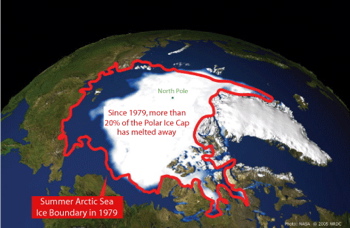
Over 2 trillion tons of land ice in Greenland, Antarctica and Alaska have melted since 2003. Think about it! It takes a huge amount of heat to melt that much ice. And that's a lot of climate-moderating ice to lose. The more we lose, the more albedo (reflective) effect is lost, so the more heating occurs, so the more temperatures rise, kicking in a vicious cycle — a positive feedback, in scientific terms.
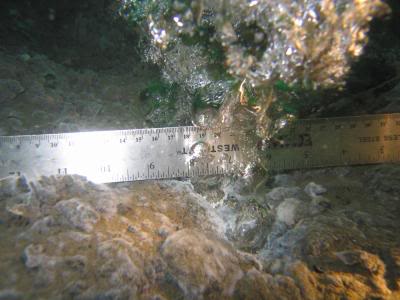
And we haven't even talked about methane hydrates (or clathrates) yet! Frozen methane deposits (called hydrates) in the Arctic Ocean seabed are melting and emitting methane into the ocean and the air. The worst danger is that 50 billion metric tons of methane could erupt at any moment from the warming Arctic. But scientists are already witnessing the melting of these methane hydrates — and an alarming (indeed, terrifying) increase in atmospheric methane, which is a greenhouse gas much stronger than carbon dioxide. Some scientists are calling this a "methane time bomb."
*****
When people say "global warming," they are actually talking about:
- global heating of the atmosphere, land and oceans
- global climate change
- global climate variation (unpredictability)
- extreme weather events all over the world
- global ocean acidification
- an increase in stratospheric ozone depletion.
So global warming is about a lot more than sea level rise or the break up of Antarctic ice sheets (which seem to get a lot of the attention). In 2001, the United Nations Intergovernmental Panel on Climate Change (IPCC) Third Assessment Report clearly stated that the risks associated with climate change also include:
- land degradation
- water shortages and degraded water quality
- food supply disruptions and hunger
- the spread of diseases and diminished human health.
That was in 2001. The IPCC Fourth Assessment Report came out in 2007. Nothing has improved since in that time. A lot has worsened. Why?
It is taking us educators a long time to realize that everything else we teach pales in comparison to the urgency, significance and consequence of global warming and climate change.
Everything else we teach will become moot — superfluous and irrelevant — if we don’t educate in a way that ensures a future.

Global warming is like a lit fuse burning towards a continually growing bomb.
It is more dire than the threat of nuclear war, which
is always just a potential (until someone actually presses the button). Our collective finger has been
on the global warming button for decades.
Since RISK = PROBABILITY x MAGNITUDE,
we are now gambling with the future of life on Earth — and the odds are definitely stacking up against us.
The Role of Teachers
What's the role for teachers in all this? We must ensure that our students
- understand both carbon cycles (short term and long term)
- learn the science of
global environmental change
- find out that developed nations adopted
international laws and treaties
that commit them to sharing their renewable energy (carbon-reducing) technologies (and the financial aid to develop them) with less privileged countries
- learn the
economics of climate change
adaptation and mitigation, and have some say in what's being done to ensure their prospects for a viable planet
- come to understand eco-equity, and how global climate change has become the greatest
social injustice
ever, because the world's poorest are the most climate change vulnerable
- leave our schools knowing how to conserve energy, reduce carbon emissions, live a
post-carbon
life, and install and use (perhaps even invent) renewable energy technologies.
Global warming is a compelling emergency and one that must inform all that we do as teachers and as people who care about our students, our own children, the Earth, and the future.
The best hope for today's generation of children and youth — and all future generations — is making global warming the overarching focus of our whole curriculum.
Return from Global Warming to Greening the Curriculum
Learn More at the Climate Change Primer Page
Go to GreenHeart Education Homepage
